
 LOGIN
LOGIN

- McDonald’s produced a very strong +6.8% comp-store increase in the US, driven by both ticket and traffic as it leaned into its value brand promise, strongly executed price / product architecture, loyalty, and winning marketing
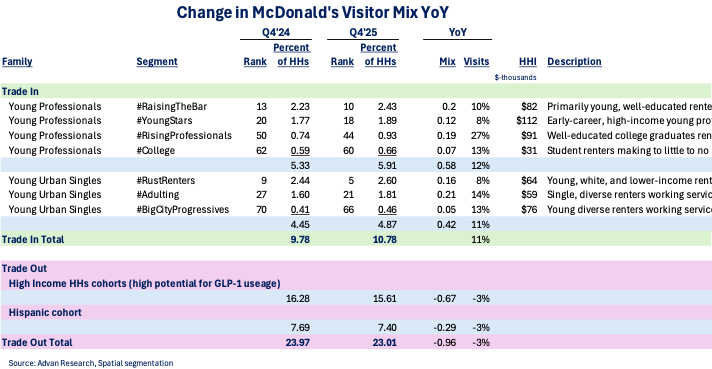
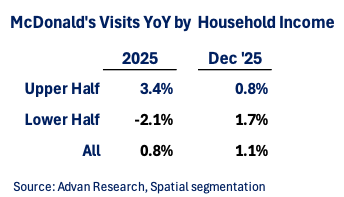
- Quarterly traffic (+0.8%) benefitted from strong trade-in by younger urban / suburban consumers (traffic +11%), partially offset by some trade-out by affluent households (GLP-1) and Hispanic households. December, by initiative (i.e. management’s intent), won strong traffic by the lower half of household incomes (traffic +1.7%).
- Overall traffic has remained strong in January and early February.
- CEO Kris Kempczinski addressed the topic of GLP-1s for the first time in public to the investor community (to our knowledge); they are watching it and responding. Advan pegs the impact to traffic at -67bps for Q4.
McDonald’s significant +6.8% US comp-sales gain (both ticket & traffic) reflected strong execution on amplifying its value position (price architecture like EVMs), new product such as wraps, promotion, a strong loyalty program cadence, etc. at a time where more consumers are seeking lower price points and greater value. The +6.8% gain exceeded Advan’s observed +5.7% estimate; the 110bps delta is the result of normal measurement error and likely stronger 3P delivery or drive-through results. Our +5.7% estimate breaks down into in-store traffic of +0.8% and average transaction value of +4.9%. QoQ reported comp-sales accelerated by +440bps, again ahead of Advan’s +330bps; again, 3P delivery and stronger drive-through are the likely contributors. The +330 can be disaggregated into +240bps from average check and +90 bps from stronger traffic*. That average check increased in a value-seeking consumer environment speaks loudly to the success of McDonald’s price-point architecture initiatives. CEO Chris Kempczinski, “We’ve listened to customers and adjusted along the way with a relentless focus on delivering leadership in value and affordability, and our efforts are working… McDonald’s is not going to get beat on value and affordability. It’s in our DNA, and we will remain agile to respond as appropriate to a dynamic competitive landscape.”
As to 2026, Kempczinski said, “As we look to 2026, success will again depend on going 3 for 3, compelling value that brings customers in the door, breakthrough marketing that creates meaningful moments for our fans and menu innovation that provides great tasting food for our customers.” Guidance was for top-line growth ahead of its benchmarked industry and operating margin expansion, impressive given the known industry challenges.
The QSR industry is suffering lackluster traffic leading to increasingly competitive actions – more limited time offers (LTOs), higher loyalty awards, faster menu innovations, and the like. Moreover, there is a lot of turmoil and cross currents beneath the surface. McDonald’s ability to drive a +6.8% comp, along with favorable company and franchisee economics, in that “rough sea” stands out and is likely industry-leading in the burger category. (Burger King domestic comps only increased by +2.6% comparatively** and Wendy’s posted a -11.3% decline.) As to the aforementioned currents, the table below breaks down McDonald’s traffic for Q4 by consumer cohort***; McDonald’s is benefited from a sizable trade-in by younger adults (that are moving out of other channels and brands), but those gains are being somewhat offset by trade-out by certain affluent cohorts (rapid GLP-1 adoption, see our work on GLPs) and Hispanics – a trend that was apparent in Chipotle’s results .
On the earnings call, management noted that December was an especially strong month for capturing traffic in more economically challenged consumer segments, which was one of management’s strategic priorities. The table below contrasts December’s customer mix changes with that of the year, clearly evident is the outperformance in the Lower Half on HHI during December. (The +360bps acceleration in the Lower Half supports and quantifies management’s assertion.) We think that the deceleration in the Upper Half in December solely reflects a lot of the “goodness” that took place throughout the year and the company’s focus during December on the Lower Half.
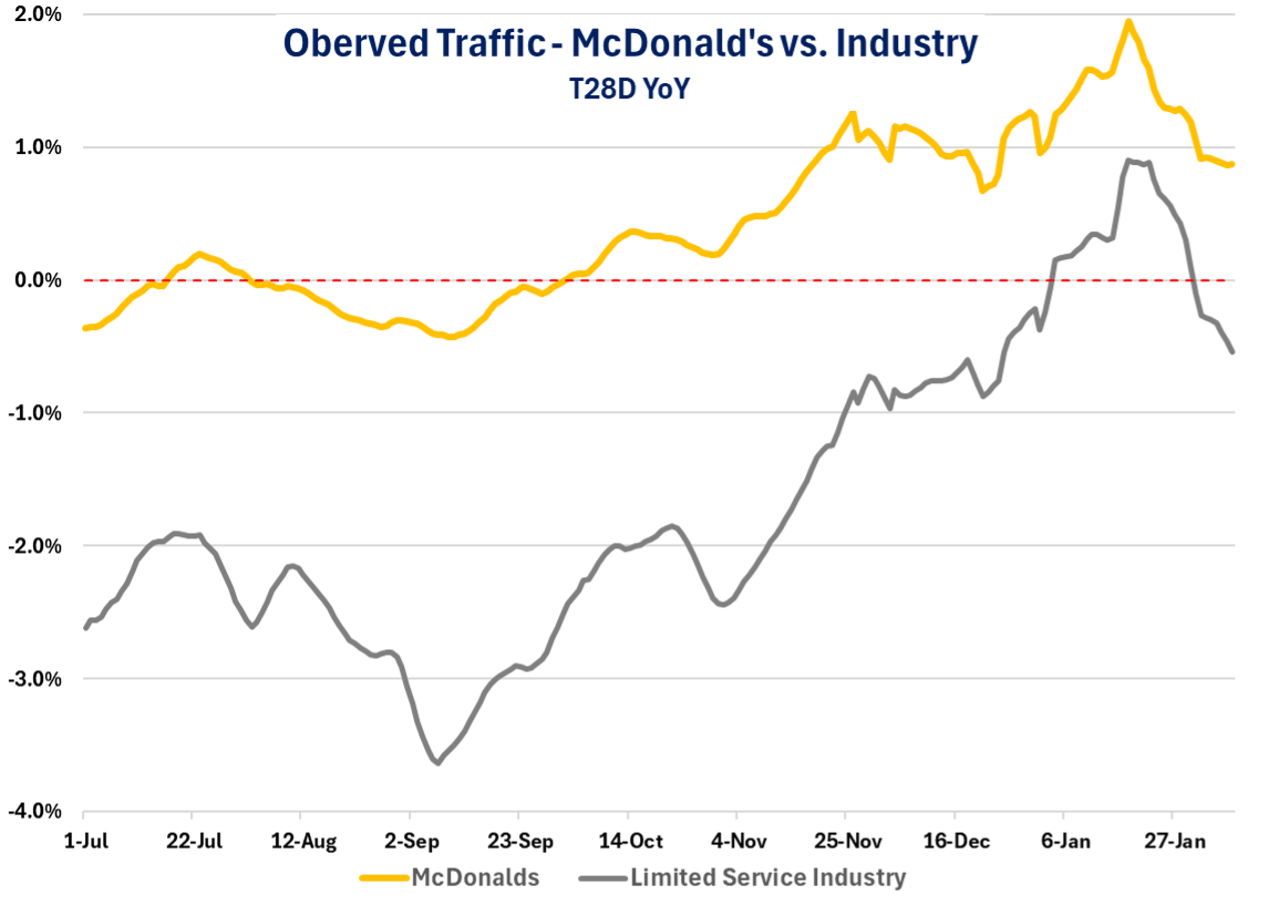
In terms of the cadence of the quarter and the January + February trend, the chart below shows McDonald’s foot traffic relative to the overall limited-service industry’s (as a reminder, Advan’s LSR index is broader than other industry “reads” and is composed of 47K establishments, includes a lot of mom & pops that others ignore). CFO Ian Borden said, “I think for the U.S., we’ve had a solid start in January. We had good kind of underlying momentum, as you’ve heard us talk about today, supported by, I think, what we’ve done with extra value meals, obviously, McValue more broadly. I think there are 2 key reasons for that. One is Q4 growth was particularly strong, obviously driven by two really strong activations in MONOPOLY and Grinch. And then as is well known, you’ve heard from many others, obviously, we had severe weather impacts in the U.S. kind of beginning in late January that pressured the industry traffic, pressured our traffic, obviously, and caused quite a few restaurants to close or reduce hours for a number of days. We estimate that weather impact to be about 100 basis points for the full quarter just when you look at kind of the drag that we saw in January.”
In terms of traffic by weekday day part (per Advan), evening was the strongest, followed by lunch, and then morning. Industry-wide, the morning day part has been more impacted by at-home / C&G substitution and individuals just skipping the meal. McDonald’s loyalty program is also a key traffic and sales driver. Visitor frequency measurable improved in Q4 (per Advan) and Borden said, “Active loyalty membership is our single most important digital metric because it – when we get consumers into our loyalty program, they visit more often and they spend more over time. And they interact with us more frequently. So they get more value in their interaction with us, and we get more value by them interacting with us. If you look at our U.S. business as an example, a customer in the 12 months before they joined our loyalty program visited us 10.5x. In the 12 months after they became a loyalty member, they visited us 26x. So we increased their frequency of visit by more than 2.5x, and they also spend more with us over time. That’s why loyalty is important, and that’s why we’re excited to kind of continue creating value so that consumer.”
On our frequent topic of GLP-1 adoptions’s impact on food service, Kempczinski said, “We’re certainly spending a lot of time and paying close attention to it. I can tell you right now, we’ve looked pretty hard, and we don’t yet see evidence of it really having a material impact on our business… We know the pill form has had pretty strong adoption in the early weeks. Lilly will come out with a pill form of their own… Our view is that adoption is going to continue to grow. And as adoption grows, we know that consumers’ behavior changes. We know that in general, they eat fewer calories in the day, but also what they eat, the mix of that changes. Fortunately, for us, protein is one of the areas that this consumer, the GLP-1 consumer is still very much interested in, and we’ve got a great protein offering on our menu. So I think that’s an area of strength for us. But we’re also seeing changes around maybe less snacking, changes in some of the beverages that they drink, less sugary drinks. And so all of those things are factoring into some of what we’re out there experimenting with and testing with.”
See our last write-up on industry trends here .
‘* Others pegged the improvement in traffic at +670bps, which is an unrealistically large number. ‘** Advan estimates Burger Kings traffic at -0.3% and average check at +2.9% for Q4. ‘*** Advan + Spatial.ai segments visitors into 80 psychographic cohorts for any given period of time. Looking at changes in the cohorts between time periods allows one to see which cohorts are growing / holding flat / declining.