
 LOGIN
LOGIN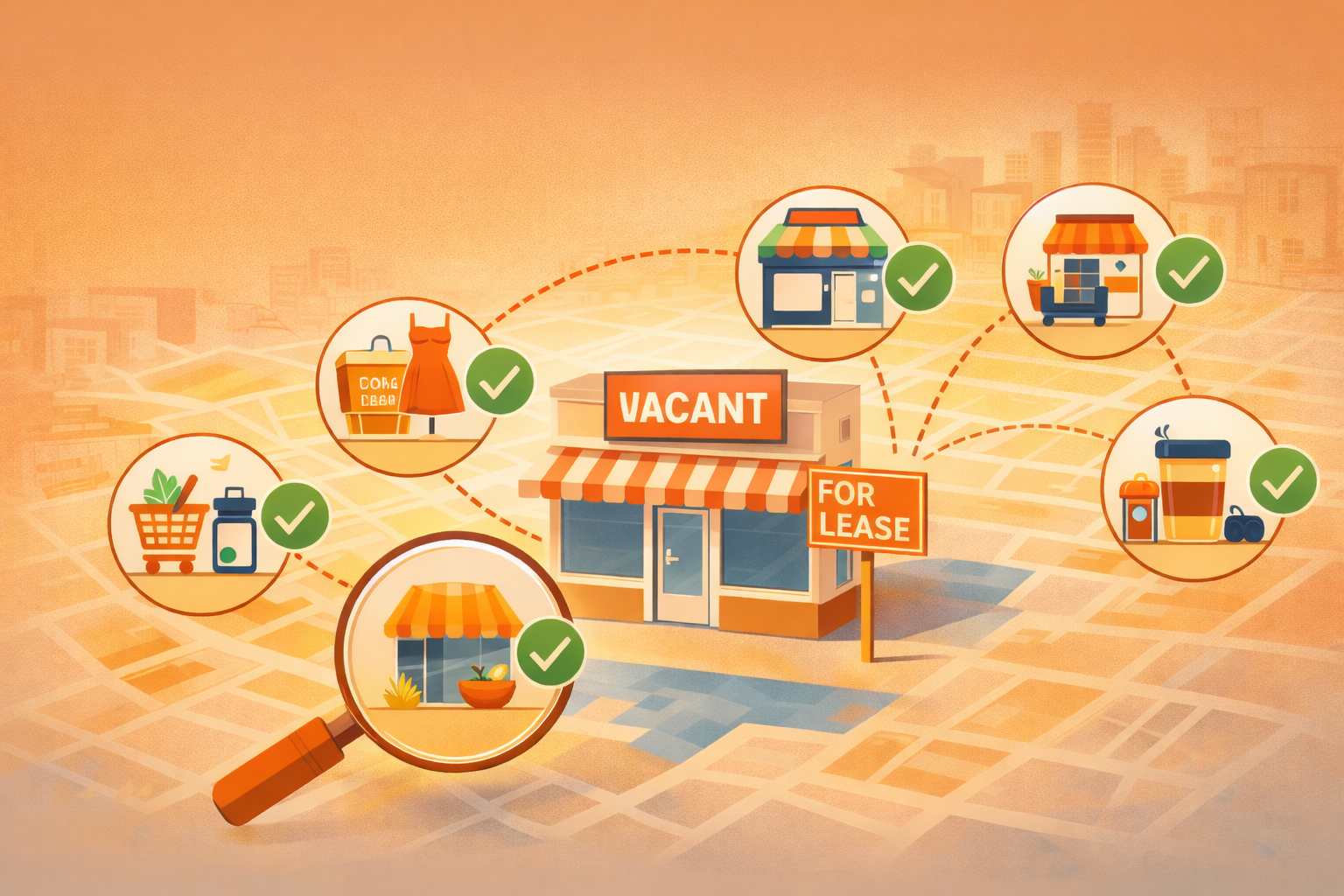
Use data-driven demand signals, not gut instinct, to fill your vacant space.
Introduction to Void Analysis
Void analysis has always been a core leasing tool in retail CRE. When space goes dark, the job is to identify what the trade area can support and match that to a tenant that strengthens the mix.
What’s changed is how quickly markets move and how much better the data has gotten. The old way still “works” sometimes, but it often leads to the same outcome: a long prospect list, slow traction, and a deal that fills space without improving performance.
This blog focuses on how modern CRE teams run void analysis with stronger evidence, faster shortlists, and a clearer tenant story.
How Retail CRE Teams Traditionally Ran Void Analysis
The classic workflow (and why it felt logical) For years, void analysis looked like a familiar sequence:
- Draw a radius or drive-time trade area
- Pull demographics and income stats
- List competitors and their tenants
- Identify “missing” categories or brands
- Build a prospect list and start outreach
It’s not wrong. It’s just incomplete. Because “missing” does not automatically mean “wanted,” and demographics don’t always explain where shoppers actually go.
Where the traditional approach breaks down
Most leasing teams have seen versions of these pain points:
- Trade areas are assumed, not observed. A 3-mile radius can include people who never shop the center and exclude people who do.
- Competitor sets get messy. The “real” competitors vary by category (grocery trips behave differently than fitness or quick service).
- Prospect lists become too broad. You end up with 40–100 “targets,” and none feel urgent or obvious.
- The pitch lacks proof. “Great demographics” isn’t enough for many modern retailers and tenant reps.
This is where data-driven void analysis changes the game.
The Modern Shift: Void Analysis Built on Demand Signals
“Missing tenants” is a weak signal A brand not being nearby can mean opportunity, or it can mean the brand already tested the market and didn’t like it. It can also mean competitors are already absorbing demand.
Modern void analysis starts from a better question: What demand exists in this trade area, and where is it currently being satisfied?
Demand signals that strengthen void analysis
Instead of relying mainly on static profiles, modern teams layer in real-world behavior signals such as:
- Foot traffic trends around the center and key competitors
- Trade area origin patterns (where visitors actually come from)
- Cross-shopping behavior (where visitors go before/after)
- Category adjacency signals (which tenant types co-occur in successful centers)
- Market momentum indicators (signals that an area is gaining or losing strength over time)
These signals don’t replace leasing judgment. They make it sharper, faster, and easier to defend.
A Story CRE Teams Will Recognize
The old story: “We think this center needs X” A space goes vacant. The team gets into a room and says: “We need a coffee concept.” “We need more health and wellness.” “We need a stronger quick-service mix.”
Then the prospecting starts, and it becomes a volume game: emails, calls, introductions, hope.
The modern story: “We can show why X will work here”
The newer approach looks different:
- The trade area is defined by observed behavior, not guesswork
- Competitors are segmented by category (not one generic list)
- Tenant targets are ranked and narrowed quickly
- Outreach includes a simple evidence pack that explains why this site fits
That last part matters. In leasing, speed often comes from clarity. When the tenant story is easy to understand and backed by signals, conversations move faster.
How to Run Void Analysis the Modern Way
Step 1: Start with the role the space should play
Before looking at tenants, get clear on the job the space needs to do:
- Daily needs convenience?
- Destination draw?
- Service and repeat visits?
- A category that strengthens dwell time and mix?
Void analysis works better when it supports a strategy, not a vacancy.
Step 2: Define the trade area using behavior
Avoid treating the trade area as a geometry exercise. The best trade area reflects how people actually shop that center type.
Modern teams often validate trade areas by looking at visitor origins and how far people travel for similar trips.
Step 3: Build a competitor set that matches the category
Your competitor set for fitness is not the same as your competitor set for quick-service, grocery, or value retail.
Category-based competitor sets reduce noise and produce cleaner “what’s missing” conclusions.
Step 4: Identify category gaps, then pressure-test them
A category gap is only useful if it survives real questions:
- Is the category already over-served nearby?
- Is demand strong enough to support another option?
- Would this add net-new trips or just shift trips?
This is where real-world movement signals help separate “missing” from “meaningful.”
Step 5: Convert category gaps into a short tenant target list
The best output of a void analysis is not a long list. It’s a short list that feels obvious.
A practical target list usually includes:
- 5–10 high-priority tenants that clearly match the center + demand
- 10–20 secondary targets that are still logical, but less urgent
Step 6: Build a tenant narrative that a retailer can repeat internally
Retailers and tenant reps want a story they can take to their team:
- Here’s who shops this trade area
- Here’s where similar trips are happening today
- Here’s why this site wins
- Here’s the role this store would play in the network
When your outreach includes that story, you’re not “selling space.” You’re making the decision easier.
Where Location Intelligence Software Drives Modern Void Analysis
Void analysis moves faster when you can prove demand and tighten the target list without spending weeks pulling inputs and debating assumptions. That’s where location intelligence comes in, because it adds real-world behavior signals to what has traditionally been a static exercise.
In practice, with tools like ADVAN’s Real Estate Intelligence (REI), modern void analysis is often improved in a few simple, non-flashy ways:
- Foot traffic as a reality check: REI includes traffic signals like trends, dwell time, and visitor frequency, which helps teams validate whether a “missing” category is actually supported in that pocket, or whether demand is already being absorbed by a competitor node nearby.
- Trade areas based on where shoppers really come from: REI’s “true trade areas” are built from observed visitor origins (by census block groups) and enriched with visitor demographics/segmentation. That helps reduce the “radius debate” and keeps targeting focused on the audience the center actually pulls.
- Shortlists that are easier to act on: REI describes a modernized void analysis approach that generates prospect lists using filters like demographic match, projected cannibalization, and market saturation. Practically, that’s how teams move from a long, generic prospect spreadsheet to a tighter set of tenants that are worth pursuing first.
The point isn’t to “automate leasing.” It’s to make void analysis more defensible and easier to execute, so teams can spend less time arguing about assumptions and more time having better tenant conversations.
Void Analysis Use Cases That Create Real Leasing Speed
Filling a vacancy without weakening the tenant mix
The goal isn’t just occupancy. It’s a tenant that improves the center’s performance and supports other tenants.
Re-tenanting after an anchor move-out
When a major tenant leaves, void analysis helps teams widen the solution set beyond “replace like-for-like” and identify categories that can rebuild draw in a new way.
Portfolio-wide tenant targeting
Void analysis can be scaled across multiple centers to identify repeating category opportunities and build a more efficient outreach strategy.
Creating stronger tenant rep and retailer conversations
A strong void analysis improves deal velocity by giving tenant reps and retailers a clear reason to engage, not just another brochure.
Common Mistakes That Make Void Analysis Less Useful
Treating the trade area like a circle A clean radius is easy. A true trade area is more accurate.
Confusing “missing” with “high demand”
A category can be missing because demand is weak, not because opportunity is strong.
Overbuilding the prospect list
A long list feels productive, but it slows action. Better to rank and narrow.
Ignoring tenant fit constraints
Prototype size, parking needs, access, visibility, co-tenancy, and positioning still matter. Void analysis should lead to targets that actually fit the box and the mix.
Conclusion
Void analysis is not new. The difference today is that the best teams treat it less like a static report and more like a living, evidence-based leasing workflow.
When void analysis is powered by real demand signals and packaged into a clear tenant story, it becomes easier to:
- prioritize the right categories faster
- target tenants with stronger confidence
- reduce wasted outreach
- fill space in a way that strengthens the center, not just occupancy
Frequently Asked Questions (FAQs)
What is void analysis?
Void analysis is a retail trade-area method used to identify missing tenant categories or brands that the local market could support, helping CRE teams target tenants that fit a specific center.
What questions should a void analysis answer?
A useful void analysis should clarify: what the trade area can support, which categories are underrepresented, where shoppers currently go for those needs, and which tenant targets fit the center’s strategy and constraints.
Is void analysis the same as a gap analysis?
They’re related. “Gap analysis” is a broad term for identifying what’s missing. “Void analysis” is usually more specific to retail leasing and trade areas, with the goal of turning market gaps into tenant targets.
What data is used in void analysis?
Common inputs include the current tenant mix, competitor tenants, trade area definitions, and market context. Modern void analysis often adds demand signals like visitation trends, trade area origins, and cross-shopping behavior.
How do you define a trade area for void analysis?
Trade areas are often defined using drive-time and access, but the strongest approach is validating the trade area with observed behavior, such as where visitors actually come from for that center type.
Is void analysis only used in retail CRE?
It’s most common in retail because tenant mix and trade-area demand are central. Similar logic can be adapted for other CRE decisions, but void analysis is primarily a retail leasing concept.