
Site Selection Data for Retail: A Practical Guide
A practical guide to the data inputs that separate a well-reasoned site decision from an expensive guess.
Why site selection can't afford assumptions
Choosing the wrong location is one of the most costly mistakes a retailer or developer can make. Unlike a bad hire or a failed campaign, a bad site commitment locks you in for years. The lease is signed, the fit-out is done, and the trade area either supports the business or it does not.
The problem is that most site selection processes still rely on data that is incomplete, out of date, or too biased to answer the questions that actually matter. A radius study tells you how many people live within five miles. It does not tell you whether those people shop in your category, whether they are leaving the area, or whether a competitor two miles away is already capturing that demand.
Good site selection data does not eliminate uncertainty. It replaces guesswork with actionable insights.
What is retail site selection?
Retail site selection is the process of identifying and evaluating potential locations for a new store or retail concept. It involves assessing whether a given location can support the volume of visits, the customer profile, and the spending behaviour that the business model requires.
It is as much an analytical exercise as it is a real estate one. The physical attributes of a site, its visibility, access, and parking, matter. But successful times must also take into account whether the right customers are actually present in the trade area and whether that trade area is healthy enough to sustain performance over the lease term.
The most important shift in retail site selection over the last decade is the move from static demographic snapshots to real-time behavioural data. Knowing that 50,000 people live within three miles of a site is a starting point. Knowing how many of them visit similar retail concepts, what they spend, and where they are moving to is the analysis that drives the actual decision.
What data do you need for retail site selection?
A rigorous site selection analysis draws on several distinct data signals. Each one answers a different question about the site, and missing any of them leaves a gap in the assessment.
Foot traffic counts: Are enough people already visiting this area or comparable locations nearby?
True trade area: Where do visitors actually come from, and how far will people travel for this concept?
Consumer spend patterns: Do people in this trade area spend in the relevant retail category?
Visitor demographics: Does the customer profile in this area match the target customer for this concept?
Competitor proximity and performance: Who else is competing for this demand, and how well are they doing?
Migration trends: Is the trade area growing, stable, or losing population over time?
Access and visibility: Can customers find and reach the site easily from the areas they come from?
No single signal is sufficient on its own. A site with strong foot traffic in a declining trade area is a short-term opportunity with a long-term problem. A site with the right demographics but weak consumer spend in the relevant category may indicate demand that does not actually convert. The value of combining these signals is in building a complete picture rather than assessing them in a silo.
How each data signal contributes to a site assessment
Foot traffic data
Foot traffic data tells you how many people are visiting a location or a comparable nearby area, when they visit, and how long they stay. In site selection, it is most useful for benchmarking a candidate site against others in your consideration set and for understanding whether visit volumes in the area are growing or contracting over time.
The depth of historical data matters here. Assessing not just current traffic levels but whether a location's momentum is moving in the right direction gives a much more reliable basis for a long-term commitment.
True trade area analysis
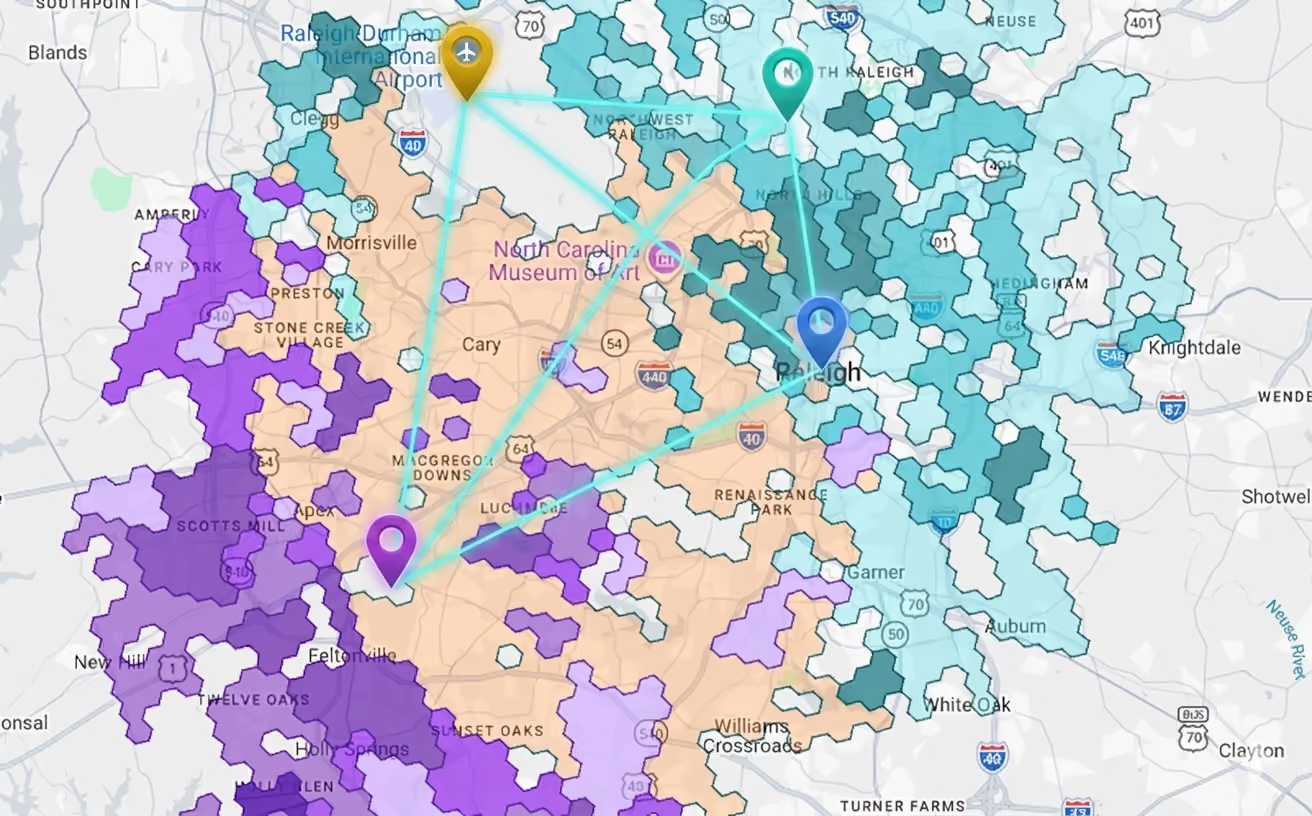
A true trade area is defined by where visitors actually come from, based on real movement data, rather than a radius drawn around an address. This distinction matters because catchment areas are rarely circular. They follow roads, retail corridors, and commuter patterns in ways that a radius study cannot capture.
Understanding the true trade area of a candidate site tells you how large the accessible customer base really is, whether that base overlaps with a competitor's, and whether the demographics within the actual catchment match what the model assumes.
Consumer spend patterns
Foot traffic tells you that people visited. Consumer spend data tells you what they did when they got there. Transaction data can identify whether people in a given trade area are active spenders in a relevant category or whether visits are not translating into purchases.
For a retailer assessing a new market, this is often the most important signal. High foot traffic in an area where consumer spend in your category is weak is a warning, not an opportunity.
Competitor proximity and performance
Understanding who else is operating in a trade area is table stakes. Understanding how well they are performing is what actually informs a site decision. Assessing competitor foot traffic, visit trends, and trade area overlap before committing to a location gives you a realistic view of the competitive dynamic, rather than discovering it after opening.
Migration and demographic trends
This is where many site selection processes fall short. Point-in-time demographic data tells you who lives in a trade area today. Migration data tells you whether that population is growing, shrinking, or changing in profile.
For a retailer signing a ten-year lease, the direction a trade area is moving matters as much as where it stands today. Relying on demographic data that is two or three years old, which is common when Census-derived reports are the primary source, can lead to decisions that made sense when the data was collected but do not reflect the market as it actually exists.
Common site selection mistakes to avoid using biased mobile data
Even experienced teams make predictable errors when the data is incomplete.
Relying on radius studies instead of true trade areas. A five-mile radius around a candidate site tells you very little about who will actually visit. Real catchment areas follow roads, transit lines, and retail habits. A true trade area built from actual movement data is almost always a different shape, and sometimes a different size, than the radius study suggests.
Treating demographic data as current when it is not. Census-derived demographic reports are widely used and widely out of date. A trade area that looked strong three years ago may have shifted significantly. Using migration data alongside demographic snapshots gives a much more reliable picture of where the trade area is heading.
Assessing a site in isolation. A site does not perform in a vacuum. Its success depends on the strength of the surrounding retail ecosystem, the quality of co-tenants, and the competitive landscape. A location that looks strong on its own metrics can still underperform if it sits in a weakening retail corridor or next to a dominant competitor.
Confusing visits with spend. High foot traffic in an area does not automatically mean high spend propensity. Combining visit data with consumer spend signals is the only reliable way to confirm that the people coming to an area are actually spending in a relevant category.
Ignoring long-term trade area trends in favour of current conditions. A site that looks viable today may be in a trade area that is losing population or shifting demographics in a direction that weakens the business case over the lease term. Point-in-time analysis is not sufficient for a decision with a five or ten-year horizon.
A practical site selection framework using location data
A data-led site selection process does not need to be complicated. It can be taken step-by-step to fully understand a site's viability.
Start with trade area definition. Use real movement data to establish where visitors to comparable locations actually come from. This defines the population you are genuinely assessing, not the one you are assuming.
Then assess demand. Look at foot traffic trends in the area, consumer spend in the relevant category, and visitor demographics to confirm that real demand exists and that it matches the target customer.
Then assess the competitive landscape. Understand who is already serving that demand, how well they are performing, and whether there is genuine room for an additional operator or whether the market is already saturated.
Then stress-test the long-term picture. Use migration and demographic trend data to confirm that the trade area will still support the business model in five years, not just today.
Finally, compare sites on a consistent basis. The value of a structured framework is that it allows you to rank candidate locations against each other using the same inputs, rather than making each site decision on different assumptions.
Frequently Asked Questions
What data do you need for retail site selection?
A thorough site selection analysis requires foot traffic counts, true trade area data based on real movement, consumer spend patterns in the relevant category, visitor demographic profiles, competitor proximity and performance data, and migration trends showing whether the trade area is growing or contracting. Using any single signal in isolation leaves material gaps in the assessment.
How do you use foot traffic data in site selection?
Foot traffic data helps you benchmark a candidate site against comparable locations, assess whether visit volumes in the area are growing or declining, and understand peak trading periods. Combined with consumer spend data, it also helps confirm whether visits in the area translate into transactions in the relevant retail category.
What role does migration data play in retail site selection?
Migration data shows whether the population in a trade area is growing, stable, or declining, and whether its demographic profile is shifting over time. For a retailer committing to a long lease, this is critical context. A trade area that looks viable today may be losing the customer base the business depends on, and demographic reports based on Census data are often too out of date to reveal that.
How do you assess competitor performance as part of site selection?
Location intelligence allows you to measure competitor foot traffic trends, trade area overlap, and visit patterns before you commit to a site. Rather than simply noting that a competitor exists nearby, you can assess how actively they are capturing demand in the area and whether there is genuine room for an additional operator.
What are the most common mistakes in retail site selection?
The most common mistakes are relying on radius studies instead of true trade area data, using demographic reports that are too out of date to reflect current conditions, assessing sites in isolation without understanding the surrounding retail ecosystem, confusing foot traffic volume with spend propensity, and making decisions based on point-in-time analysis without considering long-term trade area trends.
Site selection as a data discipline
Retail site selection has always been part art and part science. The art is understanding a market, a concept, and a customer in ways that data alone cannot fully capture. The science is making sure the data you are working with is current, layered, and specific enough to test your assumptions rather than just confirm them. The teams getting site selection right are the ones treating location data as a discipline, not a checkbox, and building it into every stage of the decision rather than pulling a report at the end.