Key Points:
- Advan’s data indicates that Giant Eagle’s business is stable and performing well, and it’s a nice tuck-in / expansion acquisition for Kroger. The store footprint and customer mix match up well.
- Giant Eagle’s KPIs have room for improvement before hitting Kroger’s level, and we’d expect them to approach Kroger’s levels once it’s been plugged into Kroger’s supply chain and IT / marketing / loyalty stack.
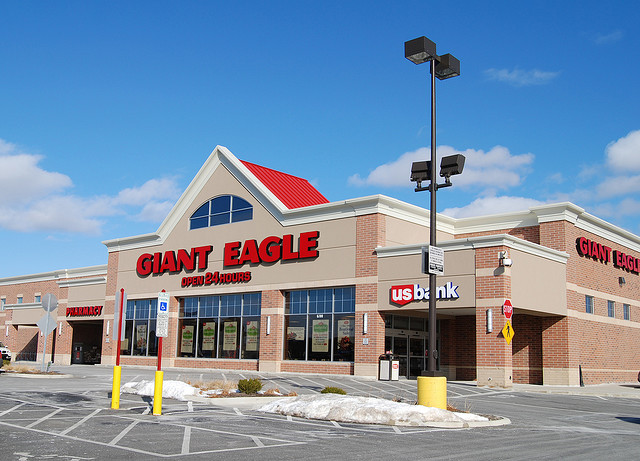
Last week’s note Kroger 2.0 Pivots to unit growth was precent given that it looked at Giant Eagle, which Kroger announced (today) that it was acquiring. Giant Eagle operates 197 supermarkets across northern Ohio, western Pennsylvania, West Virginia, Maryland, and Indiana. Based upon observed spend, its grocery sales are roughly $8B, or $40M per supermarket. Kroger does about $49M (excluding RX). As shown in the table, the Kroger banner exceeds on all the basic KPIs, giving Giant Eagle the opportunity to improve once it’s plugged into Kroger’s supply chain and IT / marketing / loyalty stack. Kroger’s press release has Greg Foran saying, "Giant Eagle is a well-run, high-quality regional grocer with a strong reputation for fresh products, pharmacy, private label, and customer loyalty. We evaluated the opportunity carefully, and the strategic fit is clear. Giant Eagle expands our reach into attractive adjacent markets, allowing us to do what we do best." (Adjacent markets was the conclusion of our last note.)


Traffic-wise, Kroger has outperformed Giant Eagle, on a 1-year and 2-year basis. On the 2-year, the outperformance is only +70bps, suggesting that Giant Eagle has done well in what is an increasingly more difficult industry – see our view that the packaged food industry’s crucible is spreading to retailers. (Just today, General Mills reported a -2% volume decline (again) in North America Retail business segment, leaving the compounded level down -8% from 2019 on an organic basis.) Given our viewpoint, plus the heightened competition from Amazon and Walmart, it’s not a surprise that Giant’s owners chose to sell to such a scaled operator. Doing so allows Giant Eagle to plug into Kroger’s supply chain and tech-stack, which creates more security for the employees and trade areas.
The shopper mix* between the two puts Giant as 2X more distinct from the Walmart-Ohio household than Kroger in summed variance (72.28 vs. 37.21). Fusion Families (Family-centered, suburban high-income HHs) are Kroger’s #1 cohort (out of 80) at 2X the nationwide average (2.23%). Giant’s #1 is Satellite Scions at 4.3X the nationwide average (1.99%). However broadly speaking, the two share a pretty similar customer mix. Again, an easy “plug-in” for merchandise planning, the supply chain, and the loyalty program.


Looking at loyalty and cross-shopping we see a similar level between the brands and Walmart and Costco. Kroger is at a higher level in shopping by Giant customers (58%) than the other way (18%), but that is simply because Kroger has 6X as many locations. Adjusting for that suggests a substantially lower level of cross-shop.

Claude.ai+Advan gave us that the overlap of Kroger on Giant Eagle’s footprint is de minimis, which also helps explain why the more moderate level of cross-shopping and why the acquisition is a nice fit for Kroger.