
Key Points:
- As expected (and previewed), TJX’s Marmaxx division delivered a very soft comp-sales increase (+1%), which reflects market share losses to Ross, Burlington, and the broader apparel category (versus a weakening consumer). Our view is that the loss is the result of Ross’ and Burlington’s brand elevation strategy of moving up into better-and-best items; an area that historically, Marmaxx (and Nordstrom Rack) had to itself.
- The contributors / detractors to Marmaxx’s +1% comp include positive observed traffic (+1.1%), positive AUR (+ markups), and a positive home category, offset by fewer items in the basket (UPT), a less compelling great treasure hunt assortment (and allocation), and a decline in comp-transactions (neg conversion rate).
- Our view is that the Saks / Neiman discombobulation kept the buying environment for better-and-best items “loaded,” but the discombobulation has now largely lapsed, revealing the more competitive sourcing environment. Recall that we expect Burlington to report comp acceleration in FQ2. Ross’ comp should decelerate, but at 9%+ nobody should be complaining.
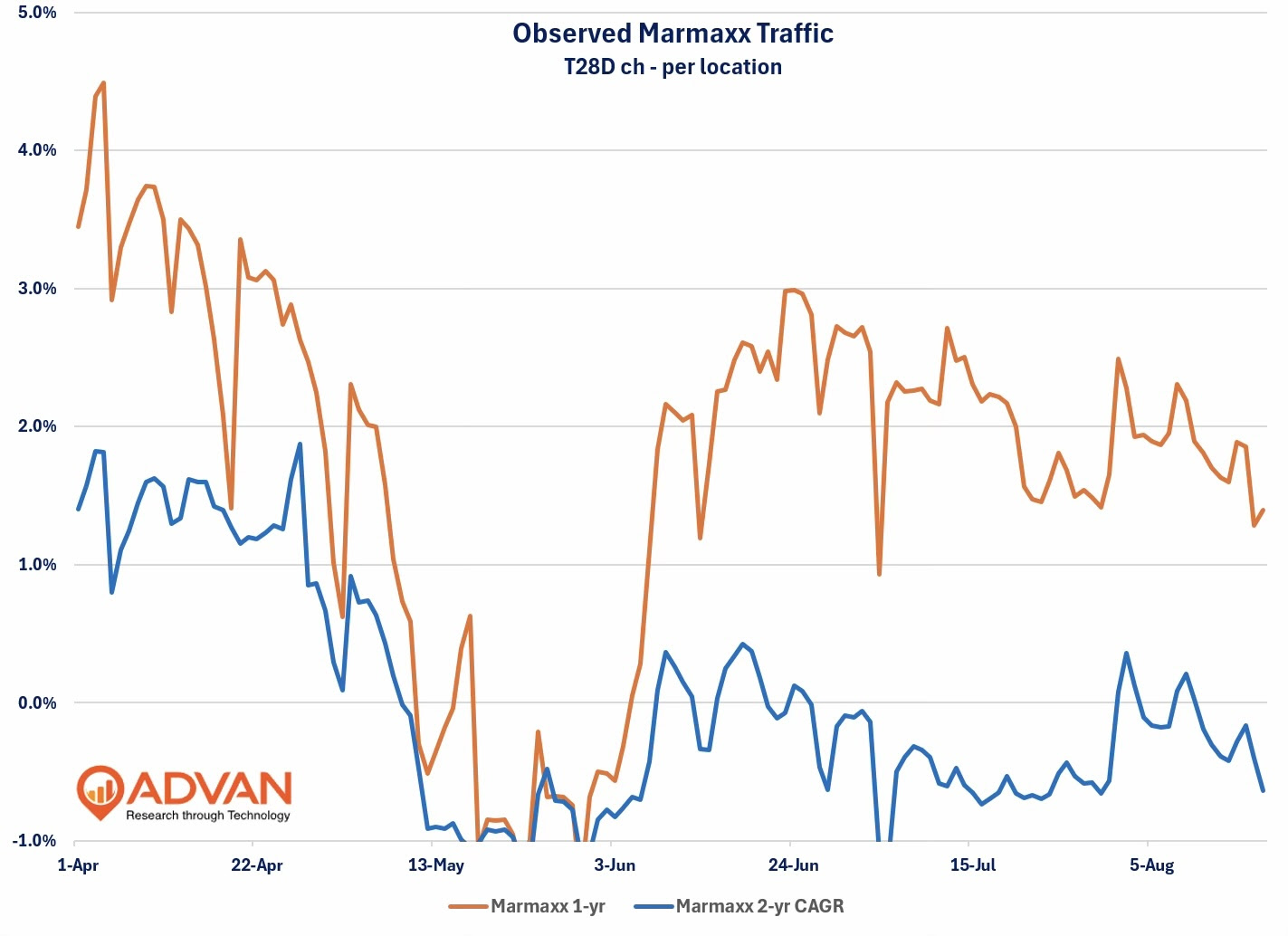
- Favorably for TJX stakeholders, the nadir in Marmaxx’s market share losses appears to have passed given the comments by its CEO and the stronger 1-yr trend in observed traffic. However, for sustained improvement in sourcing and comps, and delivering a treasure hunt shopping experience that its shoppers expect, watch the 2-yr traffic cadence, which has yet to turn higher.
As was widely expected, TJX’s Marmaxx division reported a very soft FQ2 comp (+1%); what the call brought was management’s explanation – a miss on the merchandise plan. As TJX is typically an execution machine, that the miss was self-inflicted is highly unusual, and that suggests a change in the “environment”. Moreover, we were also struck by its 2H margin guidance, where it intends to “eat” higher fuel costs versus passing it through to the consumer as is typical for them. Reading between the lines and reviewing our data, we suspect two interrelated contributors, and they are largely external rather than internal. Those are strong market share gains by Ross and Burlington, (i.e lots of $ of consumption and volume of goods), and as a result, less “high-quality treasure hunt items” availability. Starting last fall, both Burlington and Ross became much more aggressively buying up into “better and best” brands and items. Per Ross’ unprecedented comp increases and Burlington’s strong gains, it worked. Historically, Marmaxx dominated in off-price for those higher-priced goods. Additionally, the tighter market became apparent this quarter given the absence of Saks/Neiman discombobulation. 2025 was “loaded” with Saks’ “goods,” but those goods were largely sold through last year (and FQ1). And so, those goods and that inventory masked the sourcing encroachment in FQ4 and FQ1. Is competition from Burlington and Ross buyers now limiting Marmaxx’s ability to source at the prices that it historically enjoyed? In response, did Marmaxx cut back on those buys to maintain margin rate and protect gross profit dollars, hoping that shoppers wouldn’t notice? The shopper noticed something. Something changed in the assortment.
To properly set the stage about the current consumer environment / category in which Marmaxx largely participates, and what changed, 2026 is once again a fantastic year for apparel sales. The ongoing category strength stems from wardrobe refreshes, the result of GLP-1 uptake, more days in the office, and the “thrifty K-shaped economy” powered by the right upward arm. CQ2 PCE for women’s apparel was up +7.6% (men’s +8.0%), and even above last year’s fantastic increase of +6.4%. And so, the consumer and the demand environment hasn’t deteriorated or changed. +1% is far less than +7.6%.
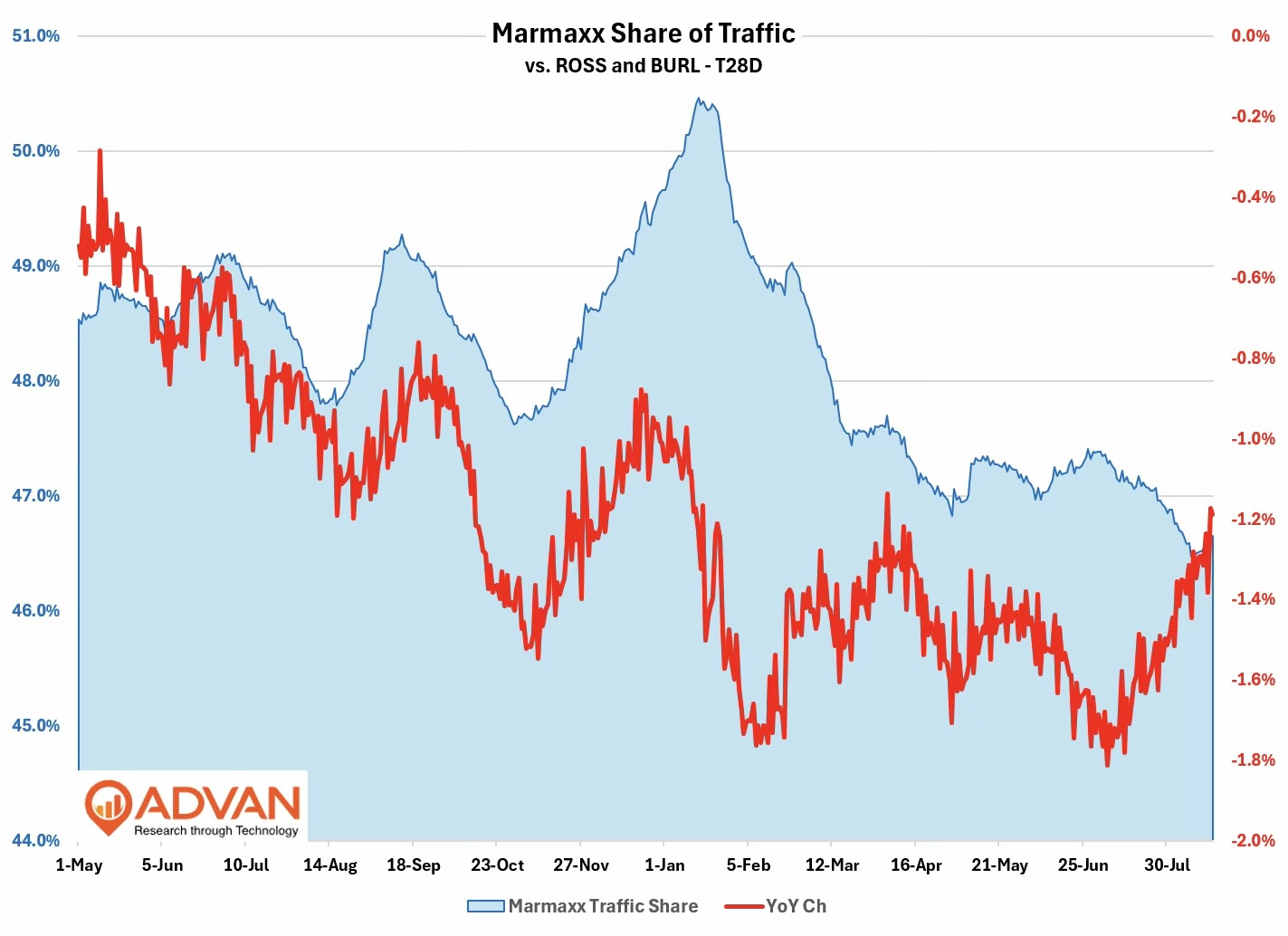
What does Advan’s data show? First off, Marmaxx has been leaking market share of traffic since last summer, and that reached a nadir at the end of this past June. We suspect that June is when Marmaxx started to respond to the leakage by its buyers rolling up their sleeves, becoming more aggressive, taking nicer to vendors and “taking them out of dinner,” putting more dollars into the vendors’ pockets (the guide), amping up marketing, etc. etc. Second, observed traffic for Marmaxx slipped -170bps QoQ, but comp-sales slipped further at -500bps. That implies that the conversion rate fell and this was also implied in CEO Ernie Herman’s explanation for the softer comp—Marmaxx shoppers didn’t find the “treasure hunt, impulse items” that they had become accustomed to.
On the execution miss Herman said, “We've identified it was pretty obvious to which areas they are in, where we did not have I would say, the right mix -- merchandise mix in T.J. Maxx and in Marshalls, and it was really entirely self-inflicted and within our control to the point that I've been involved and all teams have been involved in those areas, which involve the merchants, buyers, merchandise managers, GMMs, senior merchants, our planning and allocation teams were involved and identifying the execution issues. I mean, all the way from buyers and planning all the way up to me, and everyone's involved. We've identified them. And I think we're well on our way to fixing the issues… We know exactly where we fell down and I would tell you, we had nothing to do with if there's any question on, this have to do with any competition out there of any sorts, it had nothing to do with that. We've measured -- we've actually gone out and measured where our stores are versus direct off-price competitors. And our comps are actually pretty much identical to wherever direct off-price competitors are near us versus away from us, our stores are comping identically. So which, by the way, the good and the bad of that is it tells us it's our own execution.” (His framing of “the competition” is at the market- and street-level; he didn’t answer it at the sourcing-level.)
Herman went on to say, “We have a regular frequency of traffic*… So -- and people know that we're a treasure hunt -- right, we're treasure hunt. So they know we're going to sometimes have things or not have things. The issue is if we don't have some of these things that are kind of impulse driven, they're in the store and maybe they would have picked it up anyway… Again, I can't give you what they are for competitive reasons where we didn't have the appropriate mix. I don't think the customer knew we didn't have it, but they probably came in and weren't able to buy it.”
Herman, “… Some of the better vendors, that can throw us for a little surprise in a good way where we have some crazy deals from better vendors that can have our ticket go up short term. And then you have category mixes, and that's what I think we've talked about in the past, is the mix of certain categories within the whole store is what sometimes has made our mix go up… I think our escalation ticket will probably moderate. And that's just an educated guess over the next six months.” (To our eyes, looking back this is the Neiman / Saks discombobulation, and looking forward -- more money in vendors’ pockets.)
The fantastic treasure hunt sourcing buys that Marmaxx got in 2025 from the Neiman / Saks discombobulation have likely all been sold out of inventory and are no longer available in the sourcing marketplace. The European luxury group just reported better-than-expected Q2 results and the Americas region accelerated. There were no complaints about Saks or the US consumer on the earnings calls; orders are no longer being canceled in mass. As a result, Marmaxx now needs to roll up its sleeves, compete harder, and dig deeper for compelling treasure hunt inventory; that’s what the outlook for margins implied. Favorably, it looks like Marmaxx buyers are having some early success given that the nadir in traffic market share losses has been put in. However, for an indication that the sourcing competition / environment has moved in Marmaxx’s favor and that it’s delivering the treasure hunt shopping experience that its shoppers expect, one needs to see the 2-year traffic CAGR and the conversion rate to move higher. As shown below, that has yet to happen.
See our FQ3, FQ4, and FQ1 results reports.
‘* Other data providers say that Marmaxx’s traffic per location was negative in the 2-3% range for the quarter. It was not.