Key Points:
- On an adjusted basis, Amazon North America gross merchandise sales increased +11%, in line with the past several quarters. The growth is being driven by everyday household and personal care, and grocery.
- Based on the results and actions of the grocers, it’s clear that Amazon’s same-day perishables expansion and its 3rd party innovative sellers in non-perishable grocery are disrupting the market. Sprouts’ weak top-line results show it's being disrupted.
- Amazon’s everyday essentials and grocery business has reached $250B, and it’s growing +$25B per quarter. Walmart US’ business in these categories is $350B. It’s reasonable to assume that Amazon North America’s business will reach the size of Walmart US’ total business in three to four years.
Per our estimates, Amazon North America “Retail” grew gross merchandise value (GMV) by +11%, adjusted for the movement of Prime Day from Q3 into Q2 (which will be all of our estimates). The two most striking figures were unit growth of +15% and $250B in T4Q sales of everyday essentials and grocery, up from $200B at the start of the year. Loyal readers will know that Amazon’s expansion into grocery is a large focus of ours given the disruption that it is causing to conventional grocery and packaged food (i.e. Big Food). The expansion of Amazon’s same-day and next-day perishables even appears to be impacting Whole Foods, which grew only +2% (the slowest rate in years). The expansion is certainly hitting grocers, with the latest collateral damage being Sprouts, which tanked this week after reporting very weak top-line sales. The tone of Sprouts’ call was one in which the environment is changing faster than management expected and faster than they can control. The net, net from that call is we expect Sprouts’ +10% footprint expansion to be meaningfully curtailed in future years.
On Amazon’s earnings call, CEO Andy Jassy shared, “We're on track to reduce cost to serve per unit for the fourth consecutive year, which enables us to continue meeting or beating competitors' prices and cost-effectively deliver a broad selection of fresh groceries and everyday essentials. Increasing speed is fueling our grocery business, including perishables and everyday essentials and gross sales grew to nearly $250 billion in the trailing 12 months. In Q3, fresh groceries and everyday essentials grew about 3x faster than the rest of our store, representing about half of all units sold. (I think he meant half the growth.) Customers who shop perishables with same-day delivery buy nearly 7x more everyday essential units than those who don't. And active grocery customers shop nearly 4x more nongrocery categories like home and apparel and spend over 2x more on those categories compared to nongrocery customers.”
Per Q3 results, the 2-year CAGRs for 1P sales slowed to +6% because of mix to grocery and essentials (lower AURs), and overall sharp pricing. As such, the average ticket declined -3.7%. The 2-year CAGR on 3P sales was above trend at +12%. We suspect that 3P sellers are being very creative merchandise-wise (as is their nature) and that they are finding meaningful success in new and unique grocery items, especially in categories that Whole Foods and Sprouts are known for. Amazon would be an expert in the category, given its experience running Whole Foods.
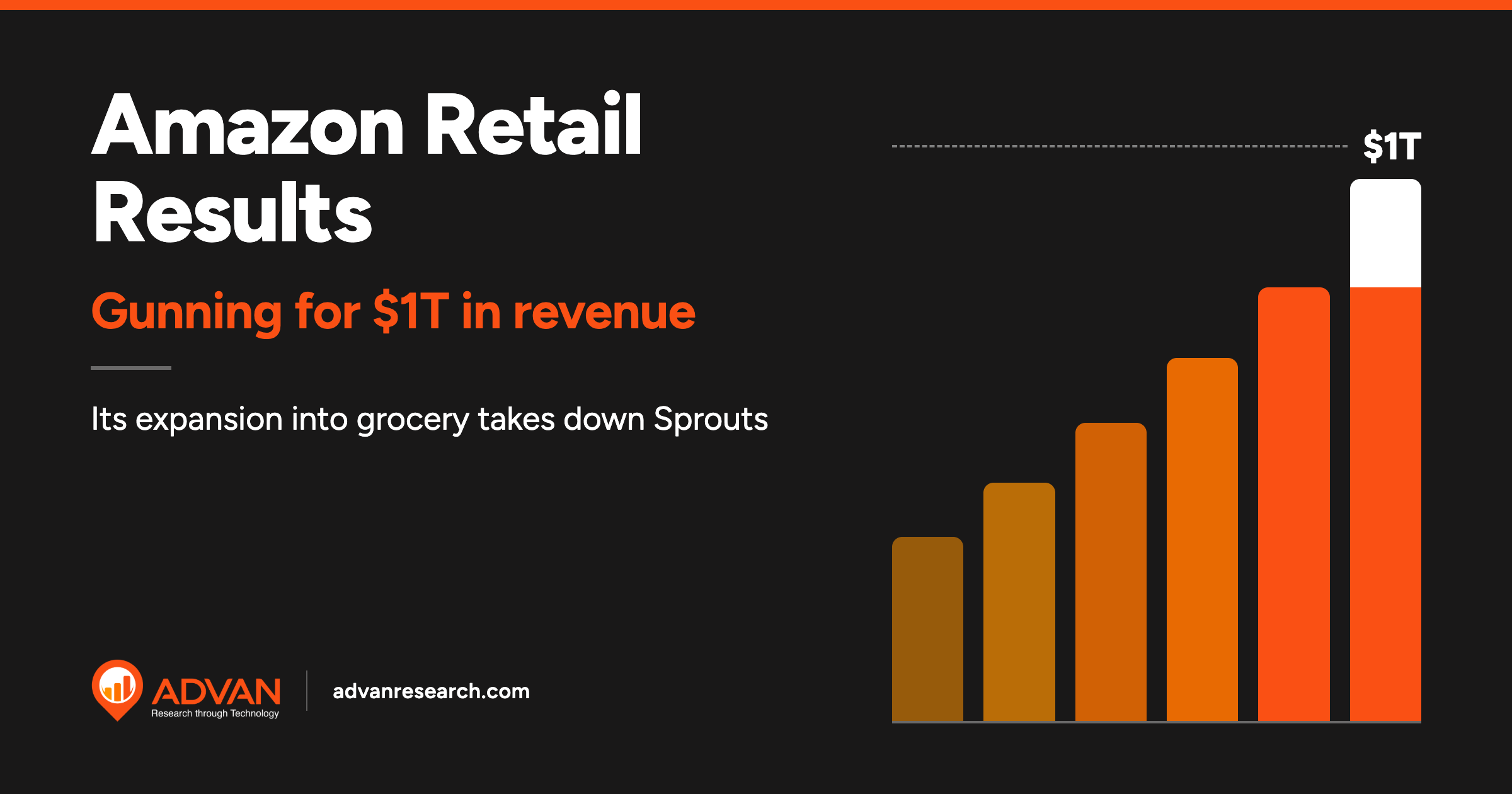
Amazon’s everyday essentials and grocery business (the $250B) is growing +$25B per quarter. Walmart US’ essentials and grocery business is $350B. Assuming that Amazon’s growth continues at +$25B, that would put it even with Walmart’s business by the end of 2027. On the call, Jassy said they had line of sight on its overall retail businesses reaching $1T in revenue, a lot of which is expected to be essentials and grocery. Based on geographic and business mix, the $1T implies around $650B in North America GMV. Assuming that Walmart can grow at a +5% rate for the next four years (not easy), that would put its reported sales at $590B, and including 3P sellers, $650B, i.e. the same as Amazon.

Amazon guided for a robust Q4, with revenue between $240B and $247B, for growth between 12% and 16%. That puts Retail’s implicit growth in the low double digits. Management typically low-balls guidance and the bulk of the quarter is the holiday (i.e. its early). As such, at the end of October, growth is likely currently running well above +16%. The activity at Amazon’s large fulfillment centers and its more localized delivery stations align with the reported results and that outlook. The 2-year CAGR at the fulfillment centers (which handle general merchandise and shelf-stable merchandise) has climbed higher during September and October. The delivery stations (same- and next-day everyday essentials and perishables) activity has remained very robust despite lapping the initial roll-out of same-day perishables last year.
ADVAN’s note on Q2 and Q1.