- Broadly speaking, fiscal results from Walmart, Sam’s, and Target were solid and ahead of plan, reflective of relatively a consistent “consumer.” Walmart said that they expected a strong holiday (as did Target), which is + read on the US consumer. We added the quote marks as the consumer is bifurcated (the K), but given that most are seeking lower price points, which has allowed Walmart and Sam’s to capture more affluent spend*. Target’s merchandise results were mixed; more work needs to be done on re-Tarjay-ing women’s apparel and home décor.
- The table below compares the revenue KPIs for the three, each are at different stages of “modernization / contemporization.” Target has the most distance to travel. Sam’s already has modernized its assortment and transformed its fulfillment (that was ’22 – ’25). A high-teens percentage of Sam’s sales volume is curbside or store-delivery and store delivery grew an incredible 100%+ in the quarter, i.e. they’ll be on their way to 25%+ by the end of 2027. Walmart modernization is ongoing (a lot shared on today’s call).
- The margin compression at Sam’s (gross margin down -50bps and EBIT down -15%) demonstrates that they are aggressively investing in greater membership value to grow membership and take members from BJs and Costco. The announced bundled* Sam’s Plus + Walmart+ is the latest salvo. (Sam’s grocery business will reach $70B this year, well ahead of Albertsons at $65B.) In addition to management’s arguments for the bundle, we also see an imperative in Advan’s cross-shop data. Sam’s members also shopping Costco has increased at twice the rate, YoY and QoQ, of Costco members also shopping Sam’s. i.e. Costco is encroaching. Lastly, Sam’s membership income only grew +2.2% YoY (bundling accounting also being a headwind to growth).
- Walmart’s momentum persisted in FQ3, striking to us is the ongoing momentum in Marketplace (+49%) and store delivery (+43%). As a reminder, it’s the merchandising insights from Marketplace (plus their newly emboldened 1P merchants) that’s allowing Walmart to move up into better- and best-brands, as well as to do more localization, that is what is connecting it with more affluent households, as is the convenience of store-delivery. Advan estimates that Walmart’s store-delivery will reach $80B for the year. (For perspective, Target’s entire retail sales is $109B, making Walmart delivery alone 75% the size of Target. Walmart gained more market share in grocery than any quarter the past three years; that’s delivery. (We’ve argued that store delivery, by all large brands, will become a significant challenge for grocery-anchored shopping centers.)
- Walmart’s large and growing advertising revenue (+37%) and membership fees (+43%) are affording it to lower prices, drive broader and faster delivery times and expand selection, while also driving solid profit growth (+9%).
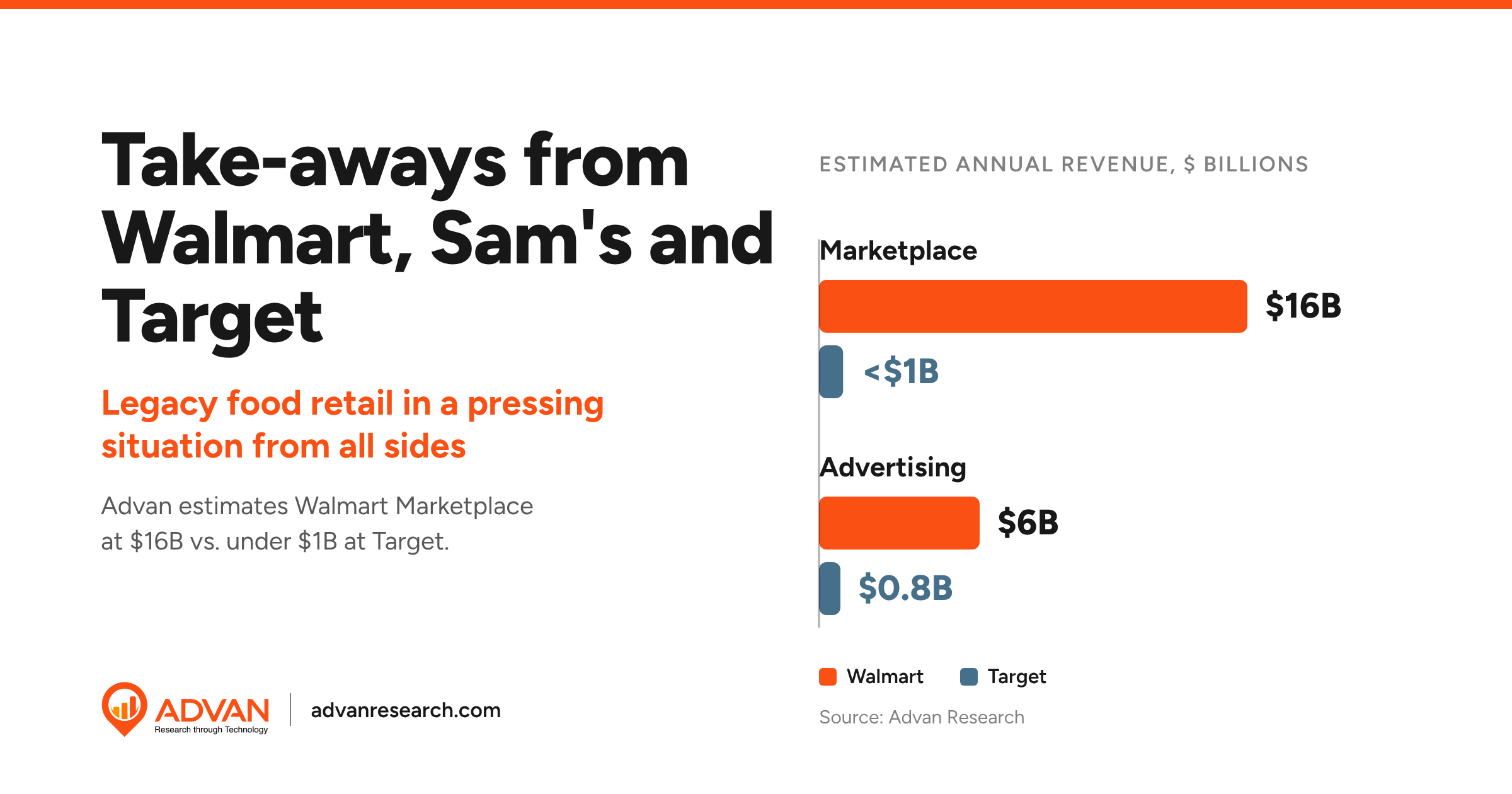
- By contrast, Target is much earlier its alternative revenue and profit streams. Its marketplace is estimated to be less than $1B in size vs. Walmart’s $16B. (Amazon’s 3P marketplace is around $510B.) Target’s advertising business is around $0.8B vs. Walmart’s $6B. Target is also just 1-year in bringing back the Tarjay. Walmart has been on its A-game year in, and year out, since pre-pandemic.
- Target showed the most positive momentum in its beauty (+9.1%) and grocery businesses (+6.6%), both critical traffic drivers for the brand, and part of the unlock for apparel and home (if they get the Tarjay right). Another proof point of Target’s improving momentum is that cross-shopping to Walmart, Sam’s, and Costco moderated YoY and QoQ. By contrast, these three retailers have seen their shoppers increase their cross-stopping to Target on a YoY basis. This is a significant favorable development as encroachment by the three on Target has been significant over the past two+ years.

Walmart CEO John Furner,
Combined with the strength of our stores, clubs, eCommerce and agentic experiences shows our value proposition transcends technological change by giving customers more of what they want, great value, a broad assortment and experiences that make their lives easier. We're seeing the benefits of this across the company. As shopping with us becomes more convenient, customers are turning to us more often. That grows our retail business and creates more opportunity for membership, marketplace and advertising. As those businesses grow, they improve our economics and strengthen our ability to invest in the customer experience… We no longer see stores and eCommerce is separate but connected parts of an integrated ecosystem. We can now reach 96% of U.S. households in less than 3 hours and 60% in less than 30 minutes. We have a unique ability to get closer to customers use inventory more effectively and deliver with speed at a low relative cost. Over 80% of eCommerce orders in the U.S. are fulfilled from stores, including our marketplace orders. By placing select marketplace inventory in stores, it brings more of our online assortment closer to customers and makes it available fast for local delivery. We can offer customers more choice while enabling our stores to support a larger marketplace business. We're also using our delivery capabilities to support fast and convenient delivery for quick-serve restaurants. We have a number of partners today and more to come. With a few clicks on the app, customers can get restaurant food delivery and a marketplace item, along with groceries, pharmacy and fashion. Only Walmart can deliver on a promise like this, and we're moving fast to scale it.