Key Points:
- Target produced very strong sales and profit results (as previewed) and indicated that there was more headroom ahead on merchandising (Tarjay), sales performance, and margin rate.
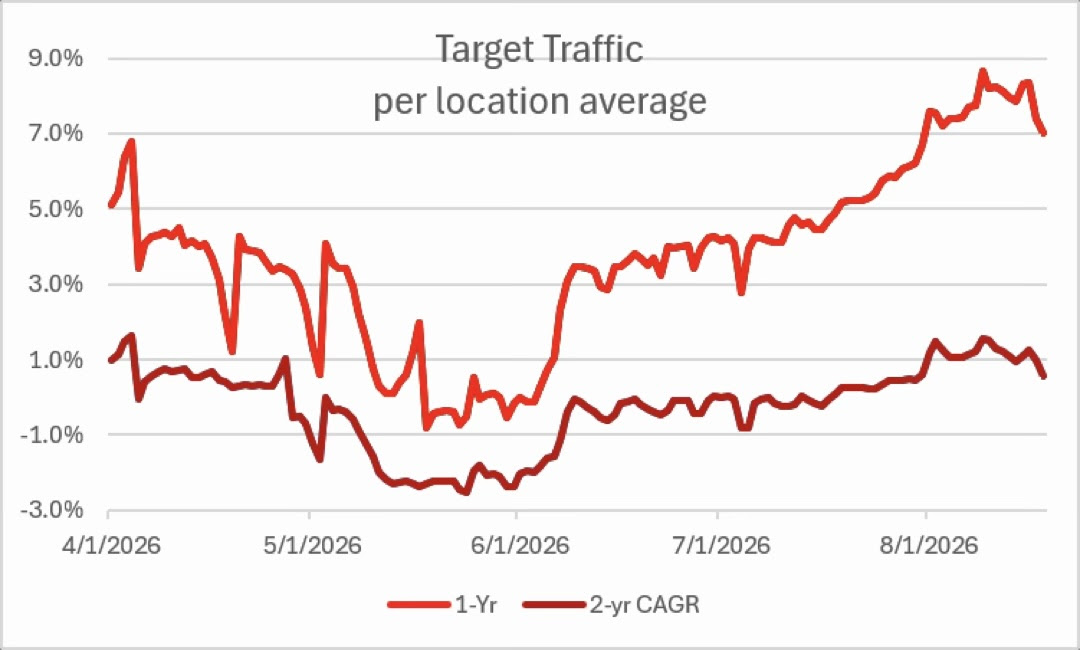
- Observed traffic (per Advan) was largely in line with the reported figure and the indicated strong start to B2S.
- July also showed a very large increase (+6%) in observed dwell time (or average stay in the store), indicating that Target’s investments in value, assortment, resets (more Tarjay), improved service levels, and higher store standards were leading to more customer time in Target’s shopping aisles perusing the merchandise. Shopper counts also accelerated nicely. These improvements also demonstrate that the teams’ new initiatives are having a meaningful positive impact on the store experience and yielding more happier customers.
- Obviously, the across-the-board improvement with the promise that more’s to come gives Target’s shareholders and stakeholders a lot of confidence in new leadership.
Target reports solid sales (+5.3%) and profit growth, with profit margin rate nicely expanding and guidance raised for the fiscal year. Contributing to the sales growth was footprint expansion (+1.3%), comp-transactions (+3.6%), and a modest lift from comp-ticket (+0.2%). As previewed, ticket (average transaction amount) is narrowing across general merchandise retailers as brands emphasize greater value to drive traffic. Comp-transactions were very close to observed traffic per location at +3.4%*. As shown in the following chart, Target is having a very strong B2S period. On the stronger traffic, CEO Michael Fiddelke said, “The guests are responding to the change that we're making and that we're earning more and more trust that's translating to more and more trips to Target. When I think about healthy indicators of sustainable long-term growth, traffic is at the top of that list. And to see the pre- and post-response from guests of where we've activated within the store is one of the things, I think, is most encouraging for us as we look at all the change to come.”
We also see evidence of B2S success in the expansion of shoppers’ observed dwell time (or visit time) during July, which was up a massive +6% YoY. That +6% is more customer time in Target’s shopping aisles perusing the merchandise. More time likely translated into more items in the shopping cart (UPT), which the sales and margin performance suggests. (Management didn’t address UPT or AUR, but given the modest expansion in average check and the comments on price investment, we judge UPT to be higher YoY and AUR, lower.)
The visit-time expansion also demonstrates that Target’s investments in store standards, service, and excitement are paying off. On the improved store experience, Chief Operating Officer Lisa Roath shared, “Overall satisfaction scores continue to improve across multiple measures of the guest experience, extending the momentum we shared with you last quarter and reinforcing that our continued investments in our teams, training and our team's tireless execution are making a difference.“ We also see support of increased satisfaction in the robust increase in observed unique shoppers during Q2, which increased at a faster rate than traffic and versus Q1.
On B2S, Fiddelke said, “I'd headline by saying we're encouraged with what we see in back-to-school and back to college so far. And we have the benefit of being out in stores a lot this time of year and to hear our guests play back what they're excited about gives us confidence that what we're offering for back-to-school and back to college is really resonating.”
Chief Merchandise Officer Cara Sylvester added, “We're still in the back-to-school and back-to-college season. This year, our combination of style, trend and value is resonating with guests. In fact, 95% of our school supplies assortment is priced at or below last year's prices. We've also enhanced the shopping experience with AI-powered teacher and college wish list and more personalized content on our app's home screen. Guests are responding with total wish list creations up more than 50% to last year, items added to these lists more than doubling and conversion across our key back-to-school pages up nearly 20%. With some important weeks still ahead, we're focused on delivering a strong finish in back-to-school and back-to-college. And throughout the third quarter, we'll continue giving our guests reasons to choose Target through differentiated owned brands, exclusive partnerships and compelling value. We've already lowered prices on more than 10,000 items over the last 12 months and are planning for additional price reductions yet this year. “ (Music to the Administration’s ears).
In terms of merchandise categories, “Fun” led (+10.6% YoY), followed by Food & Beverage (+7.2%). Target has put a lot of emphasis on the Food & Beverage category in terms of value and “distinctively Target,” and so it’s good to see success there. CEO Michael Fiddelke said, “We're delivering an incredible amount of trend-right newness while also providing outstanding value across the entire portfolio… Over the past year alone, we've lowered prices on more than 10,000 items, reinforcing our commitment to ensuring families can find a unique combination of style, quality, and affordability every time they shop with us.” And Sylvester, “When you layer on the changes that we made in Q2 with really big changes in the food and beverage business, seeing an acceleration in that business as well from both a growth, a guest engagement and a traffic standpoint.”
Sylvester also shared, “Earlier this year, I talked about our ambition to make food a destination, not simply a category guest shop while they're in our stores, but a reason they choose to come to Target. We recently completed our largest food transition in more than a decade, changing the presentation of nearly half of our center store grocery assortment, adding new and unique offerings and reimagining end caps and in-aisle presentation to make discovery easier. But this wasn't just about resetting aisles. We also expanded fresh produce, created new focals for seasonal offerings, added space for fast-growing categories like snacks, global foods and functional coffee, and continued introducing emerging brands and trending products. The response has been really encouraging. Snacks, beverages and candy were already among our largest categories by sales, and these transitions are building on that strength. For example, post transition, snack sales are running more than 15% ahead of last year with outstanding momentum in protein bars, meat sticks and better-for-you snacking options.“ (Half is a massive initiative and we’d remind readers of Albertson’s Susan Morris’ comments.)
And on Fun, Sylvester said, “In the second quarter, our teams completed a massive reinvention within the Fun 101 category. It's a great example of the intentional choices we're making to differentiate our assortment and experience. That meant evolving legacy presentations within TVs and bikes and dedicating more of that space to categories like wearable tech, LEGO, trading cards and collectibles. These are the kinds of choices we need to make more consistently, staying close to the guest, moving at the speed of culture and being disciplined about where we invest our space. One great example is our refreshed only at Target Heyday electronics assortment, where we're bringing even more compelling style, design and value to the category.” We’d also be remised if we didn’t remind readers that the Fun category is “having its moment” and the leader of Fun, Five Below, is also going to have a blowout quarter. (See our take here.)
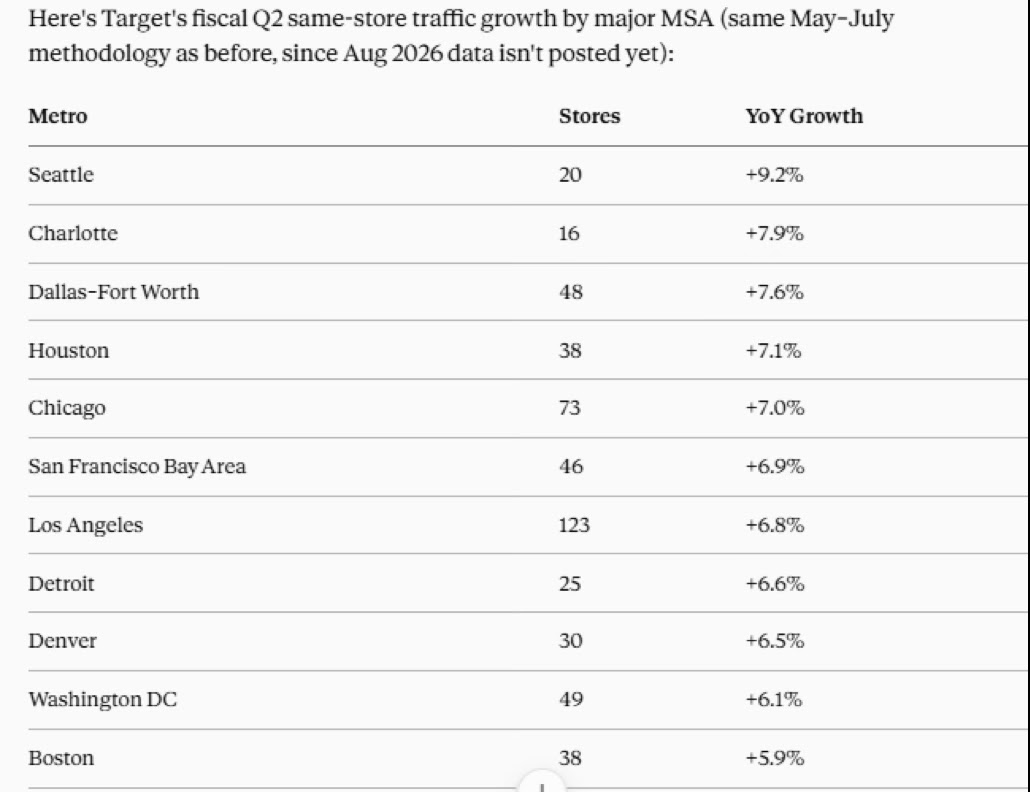
Lastly, we used our Claude.ai+Advan MCP to identify which major markets outperformed, which we show in the following. The Los Angeles figure (+6.8%) is quite impressive and meaningful at 123 stores. Target’s home market of the Twin Cities was up a solid +6.2%. (Let us know if you want more.)
‘* Others were overstated.
See our takes on Target’s FQ3, FQ4, and FQ1.